KISS of Light, Topological Insulators
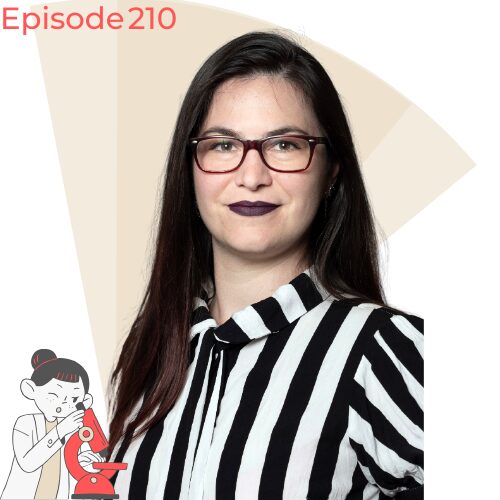
Antonija Grubisic-Cabo first came on Under the Microscope in 2020 as a postdoc in Sweden. She is back as a tenure-track assistant professor at the University of Groningen. She studies 2D materials and topological insulators out of equilibrium, hitting them with laser light to create phases that last only femtoseconds, and she co-developed KISS, a way to make large 2D layers using a single crystal of gold.
About the guest
Antonija Grubisic-Cabo is an assistant professor at the Zernike Institute for Advanced Materials, University of Groningen, where she leads research on 2D and quantum materials using ARPES and time-resolved ARPES. Since this episode she has received the 2025 Minerva Prize from the Dutch Physical Society and the Dutch Physics Council for her work on quantum and two-dimensional materials.
Antonija Grubisic-Cabo curated the Real Scientists Nano Twitter account (@RealSci_Nano) from October 16 to October 23 2023. Read all of Antonija’s tweets from that week.
Key highlights in this episode
- 02:10 Forcing materials out of equilibrium. Strong laser light can turn a semiconductor into a metal, or create phases that last only femtoseconds (10⁻¹⁵ s).
- 05:25 Why topological materials matter. Light-switched topological devices could be very fast and lose less energy as heat, so phones overheat less and batteries last longer.
- 10:10 From Croatia to Groningen. A PhD in Denmark, scanning tunnelling microscopy in Melbourne, then moving and rebuilding a lab in Stockholm during COVID.
- 18:05 The KISS method. A summer experiment with a single crystal of gold in ultra-high vacuum gave flakes up to a millimetre across.
- 34:29 Three wishes, then and now. Her 2020 wish for a permanent position came true; more time for research and simpler open science are still on the list.


Why it matters
Antonija explains that using fast light to switch topological materials could lead to very fast devices, and ones that don’t overheat, which also means better battery life because less energy is lost as heat. Her KISS method tackles a practical problem: sticky tape gives the nicest quality 2D flakes, but they are very small, and surface science needs large, uniform, clean surfaces. Doing everything in vacuum also means air-sensitive materials never touch air. Groups in Denmark, at KTH and at UBC now use the method. Her case for fundamental research: nobody knows what these materials will be used for in a few years. Graphene is not a very good transistor, but it turned out to be an excellent heat sink and useful in touch screens.
Terms explained
In the guest’s own words, with a link to the moment they explain it.
- Spin and valleytronics: in hexagonal materials like tungsten disulfide, neighbouring corners of the hexagon have opposite spin, so circularly polarised light can select electrons of one spin or the other. (Antonija at 06:41)
- ARPES: angle-resolved photoemission spectroscopy. Shine light, usually from a synchrotron, to knock electrons out, capture them, and get pictures of a material’s electronic bands. (Antonija at 10:59)
- KISS exfoliation: instead of sticky tape, a clean single crystal of gold is pressed against a layered material inside ultra-high vacuum, and a large 2D layer peels off onto the gold. (Antonija at 18:28)
Related episodes
- Supercool Electrons in 2D Materials: Antonija’s first episode, from 2020
- Simulating the Future of Quantum Materials: Antonio Manesco, the theorist who explains topological insulators
- Graphene Characterization and Technological Applications: Julien Barrier on graphene
Part of Graphene & 2D Materials · 2D materials beyond graphene
- Purifying the Future: Layers of Potential with 2D materials ft. Aine Coogan
- Stretching Atomically Thin Materials with Andres Castellanos-Gomez
- Supercool Electrons in 2D Materials with Antonija Grubisic-Cabo