How to Build a Communication Strategy for Your Research Project
How to build a communication strategy for your research project: audience, key messages, brand and platforms first, then consistent execution.
Most research projects start communicating the same way. Someone sets up a LinkedIn page, a website goes live, and the kickoff meeting gets a post with a group photo. For a few months, there is energy. Then the updates slow down, the PhD students get busy, and the channels go quiet until the final conference.
I do not think this is a content problem. It is a foundation problem. The project skipped the part that tells everyone what to say, to whom, and why. So when the initial excitement fades, there is nothing left to hold communication up.
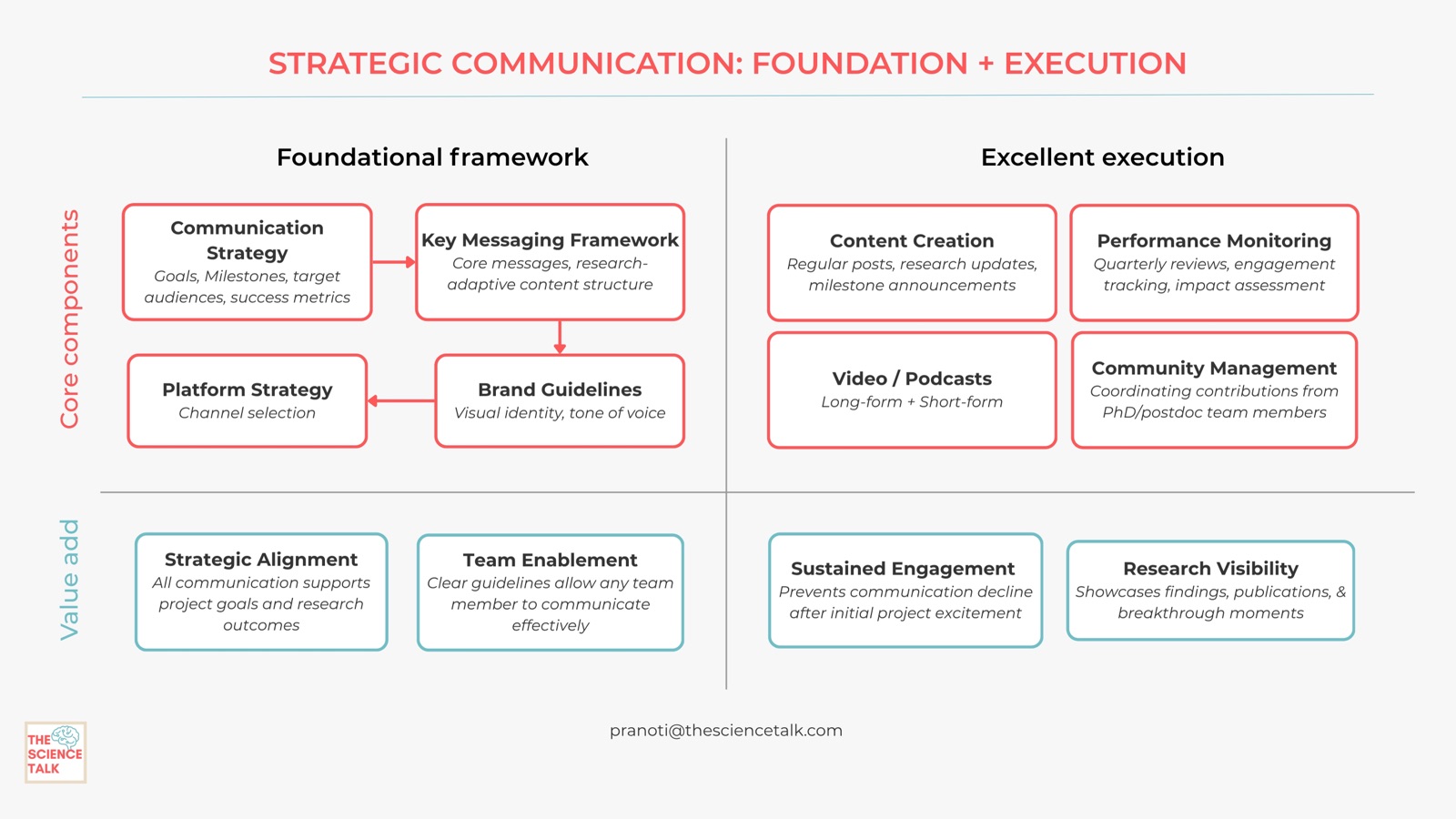
Strategic communication has two halves: a foundational framework and excellent execution. You need both. And the order matters.
In short, to build a communication strategy for your research project:
- Set your goals, milestones, target audiences and success metrics.
- Write a key messaging framework.
- Create brand guidelines: visual identity and tone of voice.
- Choose your platforms and formats.
- Execute consistently: content, video and podcasts, performance monitoring, and community management.
Step 1: Build the foundational framework
The foundational framework is four pieces of work. Each one feeds the next.
- Communication strategy. Your goals, your milestones, your target audiences, and the metrics that define success. This is where you decide who actually needs to hear about your research: policymakers, industry, other researchers, the public, or your funder.
- Key messaging framework. The core messages of the project, and a content structure that adapts as the research moves. Research changes. Results shift. Your messages need a structure that can absorb that without starting over every time.
- Brand guidelines. Visual identity and tone of voice. This is what makes a post from a postdoc in one lab look and sound like it belongs to the same project as a post from the coordinator.
- Platform strategy. Channel selection. Only now, after you know your audience, your messages, and your voice, do you decide where to show up.
Most projects reverse this sequence. They pick the platforms first, because platforms are visible and easy to set up, and work backwards from there. That is how you end up with a project account that posts to nobody in particular.
What the foundation gives you:
- Strategic alignment. All communication supports the project goals and research outcomes, not just whatever is easiest to post that week.
- Team enablement. Clear guidelines let any team member communicate effectively. Communication stops depending on one enthusiastic person.
What this looked like for QuanTour
QuanTour was a year-long global outreach campaign that followed a quantum light source across 12 labs in 12 months. Before we made a single video, we answered three questions: who do we want to reach, what do we want them to do or feel, and who else can help us amplify this?
- Communication strategy. We wanted to build an audience genuinely curious about quantum science, not just the specialists already working in it. We wanted to put the spotlight on the scientists and labs contributing to the campaign. And we wanted to partner with science societies and universities to boost credibility and reach.
- Key messaging framework. By then we knew who we were speaking to and why, so the story was simple: 12 months, 12 labs, one source. We followed the journey of the light source and the people behind it, so audiences saw both the technology and the human stories driving quantum research forward.
- Brand guidelines. We designed a QuanTour logo that changed colour and featured a monument from each of the 12 cities the light source travelled to. We created hashtags that went with every social media post. And we built templates showing partners how to use the logo when referring to the campaign, and which links to point to.
- Platform strategy. Only then did we choose where to show up: podcast, video, visuals, press coverage, the website, social media, and physical media like stickers, posters, conferences, and newspapers. The same story reached policymakers, students, and the public in different ways, without diluting the message.
It is not about being everywhere. It is about showing up with purpose.
Step 2: Execute consistently
A strategy document nobody uses is not a strategy. The second half is execution, and it has four parts too.
- Content creation. Regular posts, research updates, and milestone announcements. Regular is the key word.
- Video and podcasts. Long-form and short-form. Long-form gives depth to the people who want it. Short-form reaches the people who would never sit through the long version.
- Performance monitoring. Quarterly reviews, engagement tracking, and impact assessment. This is how you know whether the strategy is working, and what to change.
- Community management. Coordinating contributions from PhD and postdoc team members. The researchers doing the work are the most credible voices a project has. Someone has to make it easy for them to contribute.
What good execution gives you:
- Sustained engagement. It prevents the communication decline that sets in after the initial project excitement.
- Research visibility. It showcases findings, publications, and breakthrough moments when they happen, not months later in a final report.
What this looked like for QuanTour
- Content creation. Instagram-first storytelling, with the light source itself as the protagonist. Video, shorts and stills produced at lab handovers and public events. The account grew from zero to 4,800+ followers over the tour.
- Video and podcasts. A 12-episode Under the Microscope series featuring QuanTour partners, 45 to 60 minutes each. The organisers described it as “a kind of lecture series on quantum science, accessible to everyone.”
- Performance monitoring. Five engagement reports across the project lifecycle, tracking reach, audience growth and coverage. The consortium used them for internal steering and funder reporting.
- Community management. Every host lab had its own press office, language, timeline and risk appetite. I ran a single content pipeline across all 14 institutions, and coordinated press across the 12 host labs: 30+ publications in 9 languages.
The result: over a million views, and the 2025 IOP Lise Meitner Medal and Prize. Read the full QuanTour project report.
How you execute depends on your topic, timeline, goals, and audience. A one-day event and a year-long campaign like QuanTour look very different on the ground. But the process underneath stays grounded in the same structure.
Why a research communication strategy needs both halves
A foundation without execution is a well-designed plan that never reaches anyone. Execution without a foundation is activity without direction: lots of posts, no clear message, and no way to measure whether any of it worked.
The projects that communicate well over their full lifetime are the ones that treat both halves as one piece of work. They build the framework early, before the first post, and then commit to the routine that keeps it alive.
If your project is already running and the channels have gone quiet, you do not need more content. Go back to the foundation. Decide who you are talking to and what you want them to know. The execution gets much easier after that.
I unpack the QuanTour method in the podcast episode Foundations of a successful outreach strategy.
Frequently asked questions
How do you build a communication strategy for a research project? Build the foundational framework first, in this order: a communication strategy (goals, milestones, target audiences, success metrics), a key messaging framework, brand guidelines (visual identity and tone of voice), and a platform strategy (channel selection). Then execute consistently: content creation, video and podcasts, performance monitoring, and community management.
What should a research project communication strategy include? Goals, milestones, target audiences and success metrics, followed by core messages, brand guidelines and a choice of channels. Execution adds regular content, long-form and short-form video or podcasts, quarterly performance reviews, and coordination of contributions from PhD and postdoc team members.
Why do research project communications decline after launch? Most projects pick platforms and start posting before they have defined their audience, messages and voice. When the initial excitement fades, there is no foundation to hold communication up. Consistent execution, backed by performance monitoring and community management, prevents that decline.
Should a research project choose its social media channels first? No. Channel selection is the last step of the foundation. Decide who you want to reach, what you want them to know, and how the project looks and sounds first. Then choose the channels where that audience already is.
What is an example of a successful research outreach strategy? QuanTour followed a quantum light source across 12 labs in 12 European countries in 12 months. The campaign was built on a defined audience, the message “12 months, 12 labs, one source”, shared brand guidelines and a multi-format channel mix. It reached over a million views and won the 2025 IOP Lise Meitner Medal and Prize.
Browse all Perspectives or get in touch →
Found this useful? Share it or read more perspectives.