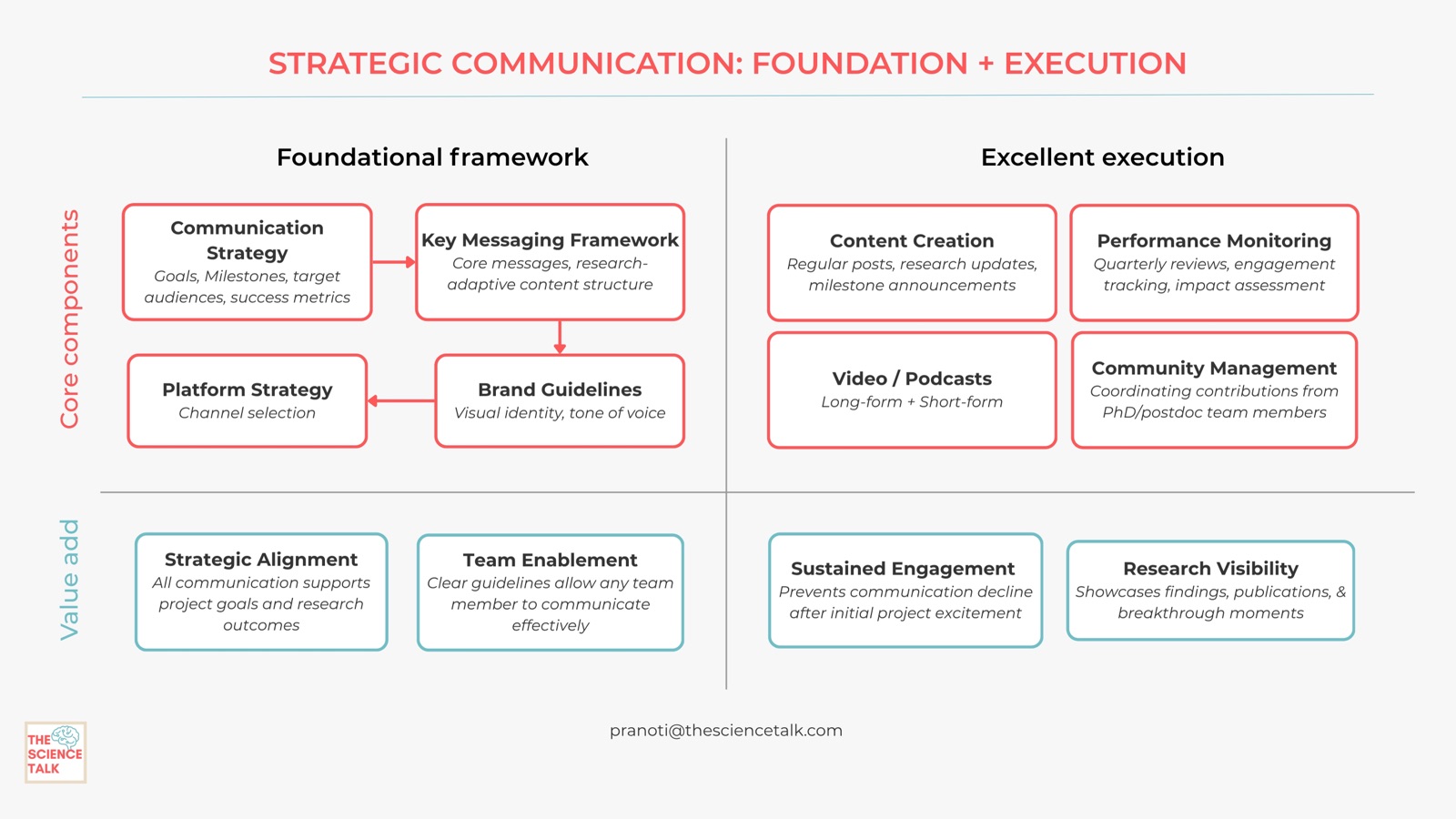
How to Build a Communication Strategy for Your Research Project
How to build a communication strategy for your research project: audience, key messages, brand and platforms first, then consistent execution.
Strategic insights and perspective on AI integration and automation in business - what evidence shows, what it means, and why it matters.
How to build a communication strategy for your research project: audience, key messages, brand and platforms first, then consistent execution.

Anthropic offers researchers a free year of Claude. This is what the plan includes, what you give in exchange, and where your research data goes.
A guide to the EU AI Act Explorer: how Articles, Recitals, and Annexes connect, using Article 50's transparency rules as the example.
Anthropic published its plan to mark AI-generated content under the EU Code of Practice: embedded text watermarks and C2PA metadata. Here is what it covers, what it misses, and why it does not replace your own disclosure duty.
Claude's data export doesn't include Claude Code sessions — a real data loss risk. Here's the local backup system I built to close that gap permanently.
The Science Talk has signed the European Commission's Code of Practice on Transparency of AI-generated Content under Section 2, ahead of the EU AI Act's August 2026 transparency obligations.
AI transparency rules under the EU AI Act are treated as a burden. Here's why AI transparency is a genuine competitive advantage, not just a compliance cost.
A practical EU AI Act checklist for small business — the six articles that actually apply, what each demands, and links to the full guide on each one.
Article 50 is now in force. What changed under the EU AI Act on 2 August 2026, what's been delayed, and the grace period small teams keep confusing with their own deadline.
The EC's own data shows Europe holds 80-90% of semiconductor equipment but under 5% of cloud and chips. What happens when even that last stronghold is contested.
The Digital Omnibus simplified Article 4's AI literacy rule on 27 July 2026. What creator agencies and small teams actually owe now, and why the exposure never came from Article 4 anyway.
The European Commission's own DSA review admits recommender systems sit ambiguously between the DSA and the AI Act. Here's what that means for teams building one.
Every EU AI Act obligation that applies to small teams and agencies — organised by audience and article, with current 2026–2028 deadlines and links to full guides.
The EU AI Act's high-risk rules were pushed to 2027 and 2028 by the Digital Omnibus. Here's why teams that stop preparing now are making a mistake.
How Claude's usage limits work in 2026: the 5-hour rolling window, Free vs Pro vs Max caps, peak-hour rules, and how to pick the right plan.
Under Article 25 of the EU AI Act, agencies can become the legal 'provider' of an AI system — and inherit every obligation. Here's how the flip happens.
The EU AI Act isn't just a labeling rule. Here's what digital content creators need to know about risk tiers, red lines, and Article 50 before August 2026.
The EU's CADA creates four cloud sovereignty tiers for procurement. Here's what the criteria mean and how to map your organisation's exposure now.
Startups building on AI are recreating enterprise lock-in patterns at scale. Here's the dependency audit every European startup should run before it's too late.
SMEs are adopting AI without mapping dependencies. Here's what vendor lock-in, the EU AI Act, and NIS2 mean for your business in 2026 and beyond.
Europe's AI adoption is deepening software dependency concentration — yet only 21% of enterprises have a governance model for it. Here's what the data shows.
European research institutions struggle to adopt Claude — here's what procurement decision-makers need to know about IT lock-in, GDPR, and AI Act compliance.
I connect Clarity, two GA4 properties, and GSC into Claude via MCP across WordPress and GitHub Pages — no spreadsheets, no downloads. Here's what changed.
Scientists and professionals keep searching for the next Twitter — but the platform era is over. Here's why the island era is here, and what to build instead.
Claude Code MCP tool access runs with your full user permissions. Here's what I discovered about credential exposure — and the five things I changed.
Strategic tips for managing Claude's 5-hour limit: model selection, batching, compact commands, starting fresh—how AI power users optimise tokens.
Claude skills degrade silently as models and connectors evolve. Without a hygiene audit, your automation library becomes unreliable — here's why you need one.
A registry gives you one list of every Claude skill and a log of each change. See how I set it up and how the 14-day audit works.
How Claude's 5-hour session window really works, what Anthropic does and doesn't confirm about peak hours, and five habits that give you more from every session.
Anthropic's Google Drive connector reads Sheets in Claude — useful for quick analysis. But write access, formula updates, and automation still need MCP.
Claude offers two Google Sheets connections: the native Drive connector for quick reads, and MCP for full automation. Here's the comparison you need to choose.
European research institutes have AI strategies but no AI workflows. Here's what the implementation gap means for research managers and what needs to change.
No perspectives in this topic yet.
Also explore
Working through AI integration at your organisation? Get in touch →