The one AI tool scientists can use without institutional approval
Why NotebookLM bypasses your university’s AI policy (plus: AI Labs is now part of our coverage)
Hello helllo!
Here’s what’s changing: Starting now, AI tools for scientists is part of our regular coverage. Not because AI is trendy, but because there’s a massive gap between what AI tools can do for researchers and what scientists are actually using—mostly due to institutional policy confusion, accuracy concerns, and data security fears. Over the past years, I’ve been quietly testing AI tools specifically for scientific workflows. Most are either unusable for serious research or violate institutional guidelines. But a few work brilliantly when used correctly.
If you’re curious about AI tools that actually work for research without compromising accuracy or violating policies? Keep reading.👇
Did someone forward this to you?
They know something you should know: AI tools for scientists that don’t violate policies.Join 500+ scientists getting weekly updates on tools that actually work.
The One AI Tool Scientists can Actually Use (Without Asking Permission First)
Scientists ask me all the time: “Can I use AI for research without violating my institution’s policy?”
My answer? Yes. But only if you know the loophole.
Most scientists are stuck. ChatGPT invents citations. Claude hallucinates methodologies. Your university’s AI committee has been “drafting guidelines” for 18 months while warning you about IP protection and data security.
Here’s what changed for me: I figured out which AI tool doesn’t trigger institutional red flags. I’ve been using it for months to turn 200+ podcast episodes into educational content.
Why NotebookLM is Different
The problem with most AI tools comes down to three things:
- You’re uploading unpublished data, confidential research, or proprietary information
- The AI might use your data to train future models
- You’re using outputs for commercial purposes
NotebookLM sidesteps all three if you follow one rule: only use published research papers as source material. Published papers are public information. No IP concerns. Google confirms your data isn’t used to train models. You’re using it for educational purposes. Even if your institution hasn’t finalised AI guidelines, you’re operating within safe boundaries.
What I Actually Tested
For The Science Talk, I uploaded 200+ podcast transcripts to NotebookLM. The results were transformative.
Here’s what I can show you: The QuanTour project—twelve podcast episodes with senior researchers from twelve European quantum science labs.
I generated:
- Flashcards with timestamp citations
- Mind maps showing thematic connections across episodes
- FAQs addressing conceptual barriers
- Study guides for progressive learning
- Audio overviews that synthesise multiple episodes into podcast-style summaries
What You Need to Know About NotebookLM
Key features that matter for scientists:
- Flashcards and quizzes from research papers
- Interactive mind maps showing connections across sources
- Audio overviews in podcast format
- Citation tracking—every output links to specific paragraphs
- Enterprise security—your data isn’t used for model training
- 130+ language support for international collaboration
What it gets wrong:
- Complex mathematical notation gets mangled
- Technical jargon with multiple meanings needs manual review
- Text-only flashcards limit use for visual-heavy fields
I had quantum episodes where only 70% of generated flashcards were immediately usable. But even that beats starting from scratch when creating educational materials.
Read the Complete Implementation Guide
This newsletter just scratches the surface. On the blog, you’ll get:
- Full 3-week implementation roadmap with timeline graphics
- Detailed institutional policy compliance breakdown
- Academic research backing this approach
- Accuracy testing data from real scientific content
- Specialised features guide (audio overviews, mind maps, video summaries)
- Exact limitations for different scientific fields
- Why this works for science communication (but only Phase 1)
Read the full guide on our website
Quick Start (If You Want to Try Now)
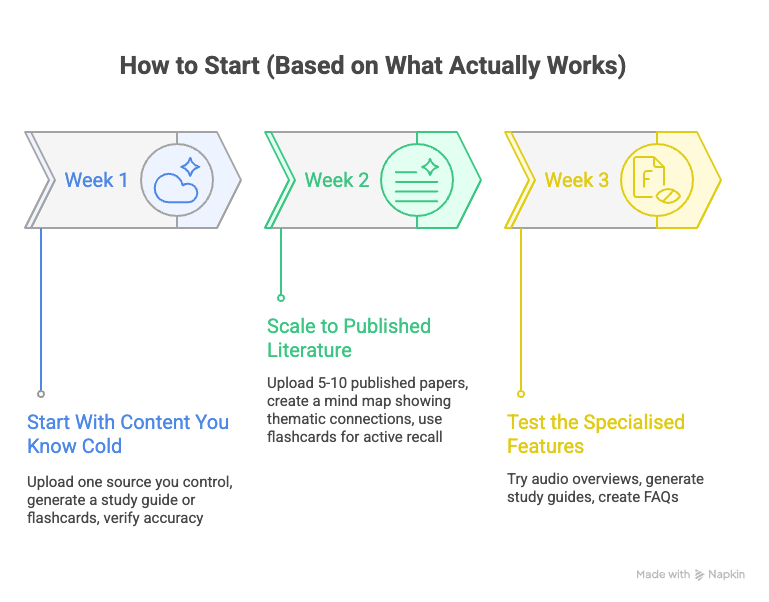
Week 1: Upload one paper you know well. Generate flashcards. Verify accuracy.
Week 2: Upload 5-10 published papers. Create a mind map showing connections.
Week 3: Try audio overviews and study guides for literature organisation.
Share your experience. If you try NotebookLM, I’d love to hear what works (and what doesn’t) in your field. Connect with me on LinkedIn or reply to this email to share your results.
Happy experimenting,
Best regards,
Dr. Pranoti Kshirsagar
Founder, The Science Talk
[Forward](mailto:?subject=The AI tool scientists can use today&body=Check this out: )